Tuesday, January 24, 2012

Tuesday Tip: Sharing Ideas with Fellow Teachers

I have had many, many opportunities to share ideas with colleagues. Some of my ideas have been appreciated and other haven't. There will be so many times in your career as a teacher to sit in roundtable discussions and share your ideas and philosophies. It is important to remember to listen as much as you talk, especially if you are a younger teacher. 

Veteran teachers have lots of very important experience to share, but that doesn't mean their way is the only way to do things. In order to cultivate mutually respectful relationships with your fellow teachers, listen to others' ideas, share your ideas and respect whatever decision is ultimately made, regardless of your personal opinions.

I will be totally honest with you, however, it's hard! I have had a very difficult time with it, especially being the extremely opinionated person that I am! But since starting my teaching career, I have learned the importance of cultivating relationships with fellow teachers. And it all begins with listening. It took me some time to learn that, so I hope you can benefit from the wisdom of my experience.

Monday, January 23, 2012

Management Monday: Beginning the Year

The first 6 weeks of school are, in this teacher's opinion, the most important. This is when I set up the routines and classroom procedures that will guide us through the rest of the year. It is more important to be consistent now than any other time. You will thank yourself later for having come up with very specific ways of performing tasks and ensuring students learn these procedures. Let's start with the most simple one - entering school in the morning.

There is so much to be done first thing in the morning. I have a very important rule that MUST always be followed though - I ask parents not to come into the classroom first thing in the morning. This is a time of routine and quiet work and having even one parent stop in for a spontaneous conference is very distracting to the day's routines.

First, student must hang up their backpacks on their hooks outside of the classroom. For the first week of school, I stand in the doorway to remind students what they need to do in the hallway before crossing the threshold. I don't allow book bags in the classroom because they are big and awkward and are a major tripping hazard.

Before entering the classroom, students need to empty their things out of their backpacks and carry their items into the room. Immediately, they put their items away and get to work on their morning math and grammar.

It is important not to introduce too many new routines on the first day. Stick to the most basic and/or important on the first day of school. After a few days, introduce another few. Also, try very hard not to have too many intricate details within each routine. The basic parts are important to hit, you can always add more specific tasks in later.

Great book! This will give you some great management strategies for the beginning of school. Especially helpful for  first-year teacher.

Saturday, January 14, 2012

I Go By ...

One of the biggest organizational problems I have had is the chaos of the end of the day. In those last 15 minutes we try to squeeze in so much and I kept feeling like things were falling through the cracks. Then there was the inevitable - "oh Mrs. Fornero, I am taking the bus today!" "Oh ya, I am going on a playdate at G's house!" "My grandmother is picking me up, I have a dentist appointment!"

In order to ensure I knew ahead of time where everyone was going that afternoon, I made it their job and part of their morning routine to tell me. But let's face it - 22 kids telling you how they are getting home that afternoon? I might remember 2. So I created this "I Go By..." board.


I used sentence strips to write the different options, then put little pieces of velcro next to the option. Each of their names were put on a strip with velcro on the back and each morning they put their name next to their transportation method.

The options were - Bus, walk, car, playdate, or after-school program. Underneath the board (not shown) was a basket where students could drop notes to me from their parents. If a student was doing something out of their normal routine, we needed a note to allow it.

I hope this helps with some organization :-)

Thursday, January 12, 2012

Valentine's Day Craft and Writing Prompt

Boy is winter here!! January 12th and we finally got some very cold weather. Totally miserable day outside - rainy, windy, and cold! I am lucky to live on the ocean or we would be socked with snow. On the plus side, snow means a snow day!

So I am in my sweats, on my couch. My 3-month-old is content in his swing and my 3-year-old is playing Dragonland on his dad's Ipad. This is a very typical afternoon for me. And the perfect time for a blog post.

The writing prompt we did was a very common one - "what does love mean to me?" I encouraged the students to think of times when they feel the most loved and the most special people in their lives. I was very proud of what they came up with.

To make it pretty, they did their final drafts inside of a heart on white paper. I then gave them pink, purple, red and white tissue paper. Their challenge was to decorate their paper with little, scrunched up pieces of the tissue paper and glue them down in a unique design on their writing samples. The purpose of the challenge was to strengthen their "alligator fingers." These are the muscles in the fingers they use to write. This is especially helpful for students who have poor penmanship. Since we still teach penmanship in our school, I felt it was important to do exercises such as this to work on forming letters and gaining more control of their pencils - a problem for many students.

I think the finished product came out really cool!

Wednesday, January 11, 2012

President's Day Lesson

As part of our President's Day unit, the 3rd graders in my class last year learned how to retrieve information from two articles, one about Abraham Lincoln and one about George Washington (I got the articles off www.abcteach.com). We used yellow highlighters to highlight important information, pink to highlight unfamiliar words, and green to highlight text to self connections.

Once finished reading and highlighting the articles, I passed out Venn Diagrams to the students. I did a mini lesson on how to use Venn Diagrams to compare and contrast two items. We then placed information from the articles onto the Venn Diagram to compare and contrast two Presidents.


Hall of Presidents

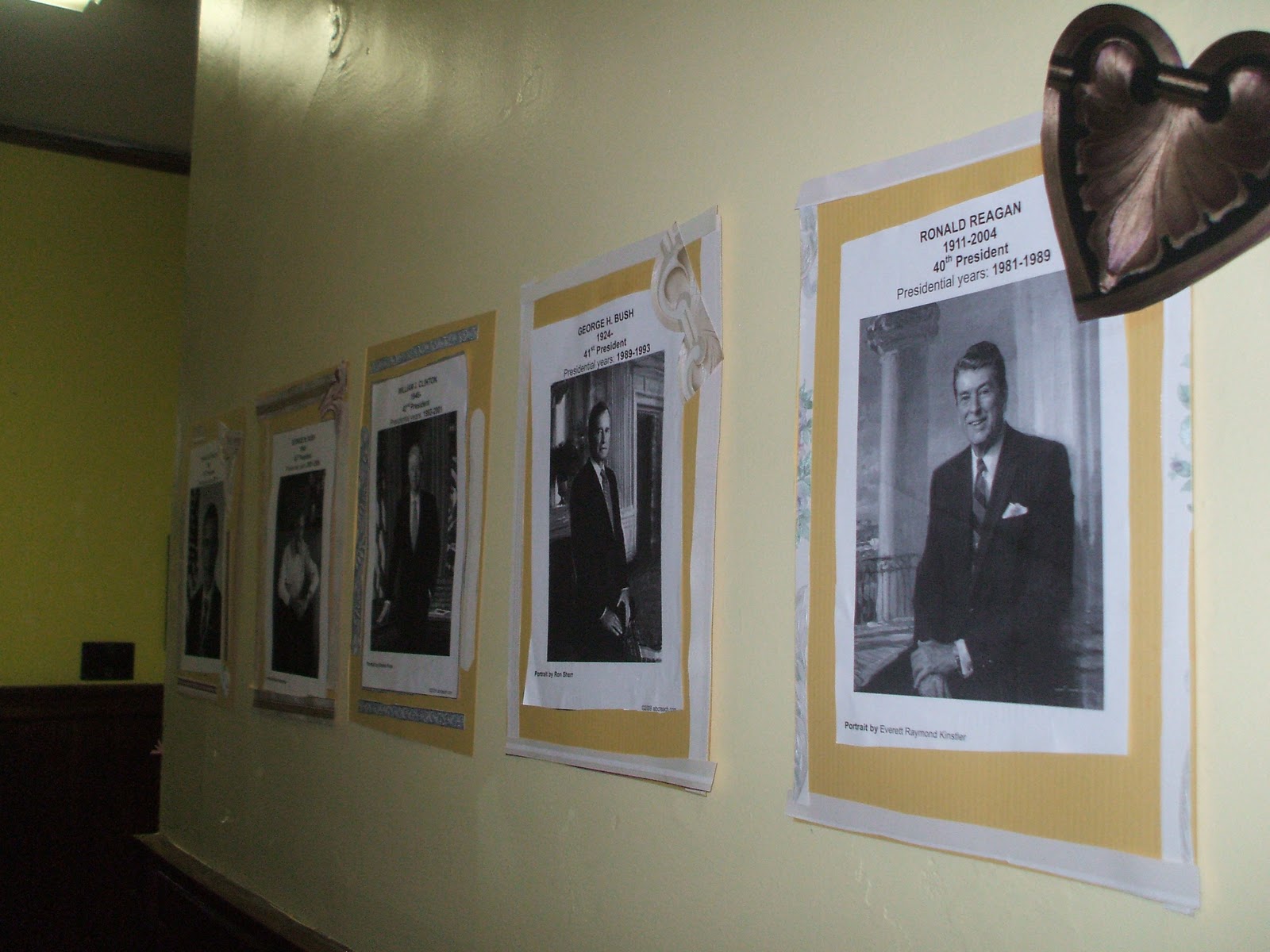
I did this great craft last year for Presidents Day. I printed out 8x10 photos of each of the 44 Presidents from www.abcteach.com and we made "presidential-looking" frames to go with each one. We used remnants of wallpaper samples to create a surround and glued the photos onto the background. We had some great discussions about each President as the students created the frames. We then taped the framed photos up onto the wall in the hallway outside my classroom and named it the "Hall of Presidents."


Monday, January 9, 2012

Soil "Trifle"

I am constantly trying to come up with ways to make lessons more memorable to students. This is one that students from 3 years ago still talk about. In fact, the day I did this lesson, I had an eighth grade student visiting in my room and he still asks about it too!

This lesson was to teach about the different types of soil - sandy soil, loam soil and clay soil.  We then made edible "soil layers trifle." Which, of course, they got to eat when done (the best part!) Just be aware of any allergies your students may have. Some have uncommon allergies that you might not think of - it's not just peanuts anymore!


The ingredients I used:

loam soil - crumbled chocolate cake - you can also use crushed chocolate cookies)
sandy soil - crushed Nilla wafers (or graham crackers)
clay soil - crumbled red velvet cake
silt - marshmallows (or whipped cream)
animal fossil - gummy worm
plant fossil - mint leaf


The students were given their materials in plastic bags, already portioned out and labeled, a plastic spoon for "digging", a clear plastic cup, and an observation sheet. I gave them enough to do 2 trifles - so they could eat one on the spot and take one home to show their parents (and eat after dinner!)


There are also many ways to do this lesson with non-edible items. If your school has rules about using food items for lessons, find materials that are non-edible, but try to keep the colors as close as possible to try to represent the real thing. Here are some suggestions:

loam soil - dirt
sandy soil - sand
clay soil - red/maroon crayons (crushed - easy to do with a sharp knife)
silt - salt
animal fossil - plastic animal figure (easy to find at the Dollar Store)
plant fossil - plastic plant (also easy to find at the Dollar Store - look for packs of little dinosaurs, they have the animals and plants in the same pack)

When we finish science lessons - I always pass out a "self-assessment form." This is an opportunity for students to grade themselves. They are given a rubric with points from 0-4. I find that the students are always harder on themselves than I would ever be on them! 

The scale:
    0 = no attempt was made
    1 = I didn't really try very hard and I need to work harder on this next time
    2 = I tried, but I had a hard time and will keep trying
    3 = I tried and got most of the work done right
    4 - I worked hard and followed all directions
   

1. Did I follow all directions as given?    
2. Did I work well with my partner? Did I give him/her a chance to speak and did I listen to him/her?
3. Did I pay attention and stay on task?
4. Did my product turn out the way I wanted it to?